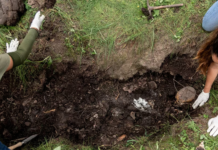



Somewhere in the state of Colima, in the heart of nature, hidden among mountains and ancient silences, there is a place that is beginning to reveal its secrets.
This is El Coral, an archaeological site recently registered as a National Cultural Heritage Site, which could change what we know about the most ancient origins of western Mesoamerica.
“We are going to a place that has been jealously hidden in nature, in the history of Colima. It is a place that still holds many mysteries,” says photojournalist Rafael Cruz, one of the site’s discoverers.
The site was first identified in mid-June 2020, during a helicopter overflight conducted by the photographer as part of his work.
From the air, among the foliage, vestiges could be distinguished that suggested the presence of an ancient pre-Hispanic city. Weeks later, together with photographer Jonathan Villa, they carried out a land expedition to corroborate what they had observed.
“Walking through the area, we were able to perceive different types of constructions… what we can see are lines measuring some 20 meters or even up to 15 meters, and walls up to 1 or 2 meters high,” Villa notes. The photographs were sent to the National Institute of Anthropology and History (INAH) in September of that same year, who confirmed the significance of the discovery.
El Coral, as the site was named after a tree of the same name found in the area and a stone encrusted with marine fossils, is located in a difficult-to-access region.
It is surrounded by dense vegetation and protected by its isolation. To reach it, it is necessary to cross several communal land plots, which has favored its natural conservation.
According to initial analyses, the site may have been a ceremonial center of great importance. What have been identified are altars, plazas, canals, water catchments, foundations, and even possible ball courts.
A stone located on a staircase welcomes visitors to the site, and there is speculation that it could be a solar marker, used to observe the zenith passages, equinoxes, and solstices.
“There are many structures around here, as you can see in the images… canals, water filters… perhaps even a ball court,” says Cruz.
El Coral could be culturally linked to the ancient city of La Campana, one of the most important in western Mesoamerica, whose splendor dates back to the Postclassic (1521 AD), with cultural influences that even include Teotihuacan traits, and whose origins date back to the Preclassic (around 1700 BC).
Some hypotheses even suggest that it could be the mythical lost city of Almoloyan.
“This discovery is unlike any other. So far, my friends and I in a multidisciplinary group have submitted 410 reports related to archaeological finds in Colima, but this one includes structures. It’s something larger, potentially dating back to the very origins of our cultural identity,” says Rafael Cruz.
Although the visible structures are only a fraction of what could be buried underground, the official report to the INAH guarantees their protection.
The next step will be to conduct in-depth archaeological studies that will allow us to establish a precise chronology and more clearly understand the site’s function.
“Perhaps with subsequent studies they can find some clue that sheds light on what it might have been like, and place it in a specific time period… with ceramic, bone, or vestige evidence of the civilization that may have existed here,” concludes historian Osvaldo Mendoza.
The Coral not only represents an archaeological find. It is also a gateway to memory, an opportunity to reconnect with the roots of a territory where the heart of Mesoamerica still beats.

Source: milenio