

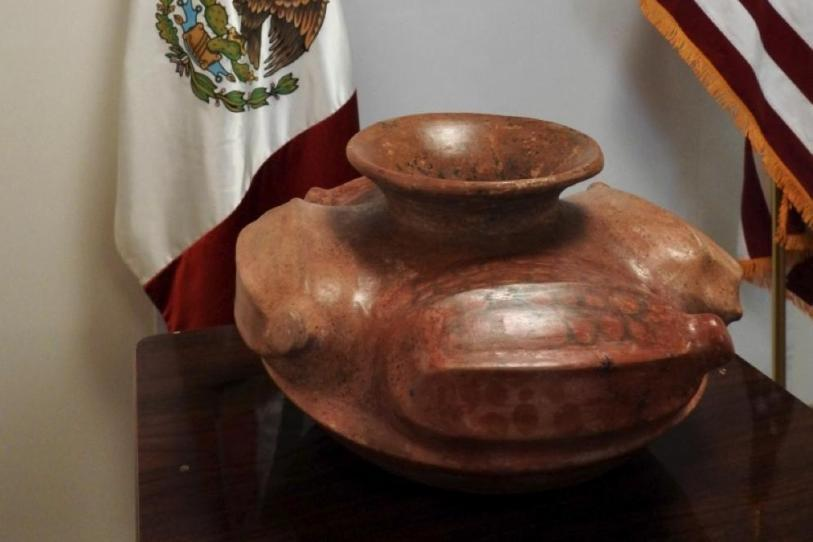

The archaeological piece, produced between the Terminal Preclassic and Classic periods, was identified by INAH specialists as part of Mexico’s national cultural heritage.
A Mexican archaeological artifact that was in the possession of the Institute for Cacao and Chocolate Research was returned to Mexico at the Consulate General of Mexico in Boston.
It is a pre-Hispanic vessel made of modeled clay, with a polished surface, reddish slip, pigmentation in another shade of red, and applied decorations. It belonged to cultures established in the territory that is now the state of Colima and was manufactured during the Mesoamerican Terminal Preclassic and Classic periods (300 B.C.-600 A.D.).
Mexico’s consul general in Boston, Carlos Iriarte Mercado, highlighted that:
“The restitution we are celebrating demonstrates that culture has the ability to unite us and build meaningful collaborations between institutions, communities, and countries. Each return strengthens Mexico’s connection with its history and confirms that international cooperation and cultural diplomacy are fundamental tools for protecting our heritage.”
It is a phytomorphic vessel whose body depicts four cacao beans; the neck has straight, divergent walls and a rounded rim.
The analysis conducted by researchers from the National Institute of Anthropology and History identified it as a movable archaeological monument belonging to the cultural heritage of the Mexican nation.
Source: excelsior